Monday, January 9, 2023

2023 Is Here


                                           Time to kill young winter weeds like chickweed.


Horticulture Hotline 01/09/23

By Bill Lamson-Scribner


Are you ready for the 2023 season in your yard? Plants seem confused and so am I. Cold, not cold, winter, not winter. Who knows? The warm weather between cold snaps has kept large patch and mole crickets very active. Charleston – the hardest place to grow grass…


Here are a few things to do on these nice winter days.


·         Take some soil to Possum’s to get the soil tested – for everyone that has not already. Get on a Custom Program for your yard for 2023.

·         Kill winter weeds now while they are young. It is easier to kill weeds when they are young and actively growing. Once they go into their reproductive mode and start to flower and seed, weeds are much harder to kill. While your grass is dormant is a good time to control weeds too as opposed to the heat of the summer or when the grass is coming out of dormancy in the spring.

·         Take mower in to have serviced to beat the Spring rush. With the new ethanol gas lawn mower engines and other engines have had issues. When your grass needs mowing now, no one likes their mechanic to tell them, “pick it up in 4 weeks.”

·         Keep leaves off lawn areas. Keeps moisture from being trapped and if you or your lawn service are applying products, you will have a more uniform coverage without the leaves.

·         Move any shrub or tree now before it is too late. Root prune now, move before they start putting on new growth. Try DieHard Transplant to help survival.

·          Spray trees and shrubs with paraffinic oil (ultra-fine, Omni Supreme oil) as opposed to petroleum oils (Volck) to control over-wintering insects. Watch temperatures. If you have ongoing issues with scale, aphids, white flies, or other sucking bugs, try Safari or Dominion for long term control. Neem oil works on diseases as well as insects.

·         Have you tried Lime / Sulfur spray around the ground of deciduous plants that get diseased? Roses, hydrangea and blueberries are good examples of plants that benefit from this sanitation practice.

·         Sharpen pruning tools or purchase new ones.

·         If you haven’t already, get your bulbs in the ground.

·         Apply SeaHume to turf, trees, flowers, and shrubs. Adding organics now will help in the spring. Cotton Burr Compost put out in October is producing great runners still. Love those dark red runners in January!!

·         Re-do bed lines to reflect maturing landscape.

·         Get bird house ready for nesting birds.

·         Have moles, get Mole Patrol or Repellex Mole Repellent – they really work.

·         Have deer, get Deer Stopper – it really works.

·         Check irrigation or get on professional’s list to check. Be sure the heads are pointed the right way. Can you eliminate (turn off) the zone watering the shrubs and trees? Have you tried wetting agents to lower your water bill (we hear between 30 and 60 percent)? Less water equals less disease.

·         Prune Crepe Myrtles – don’t butcher them. Remove crossing (rubbing) limbs, inward growing limbs and diseased limbs to open them up for better light penetration and air movement. Topping or reducing their height is not considered proper pruning.

·         Hold off on pruning plants damaged by the cold – we could still have more freezing temperatures.

·         Test well for salt if you use a well for watering.

·          Get ready to preemerge in February. Kill small seeded summer annual weeds before they take over your landscape.

·         Get out and enjoy our County, State and City parks as well as our local plantations.


Always read, understand and follow product label. The product label is a Federal Law.


                                               Hope you had your Hopp'n John and Collards

                                                      Grass already greening up. Get Ready!
 

Monday, January 2, 2023

BUURRR Cold


                Lil Possum Hits The Holiday Festival of Lights. Ol'Boy is missed but not forgotten.
 

Horticulture Hotline 01/2/2023

By Bill Lamson-Scribner


Wow, what a difference a week makes! I thought I was going to be writing about different strategies in the landscape or pest around the house, and the craziest cold weather hit that I can ever remember.


I’m very glad and thankful that this event wasn’t an ice, break limbs of trees, knock down powerlines, and knock out the electricity for thousands of people for days type of storm. Come to think of it, it seems that the ice is always the bad guy. Slip while walking on the ice on the driveway, slide while driving on the ice, ice building up on tree limbs causing them to break and damage something else including powerlines, cars, houses, and people…


Ironically, in agriculture ice is used to protect plants from the cold. Strawberries and citrus are the two crops that come to mind that are most commonly protected from the cold by spraying a thin layer of water on the plant and turning it to ice. You have to know what you are doing because too much ice will split limbs.


Of course, I’m already being ask what should I do for my lawn, trees, and shrubs after this “event”. Being the soil test geek that I am, I always recommend taking a soil test to figure out what the soil is needing or has too much of. I still haven’t met anyone, and I hang around some pretty sharp agronomist, that can look at a lawn and say you need 15#/M of dolomitic lime on that lawn. Labs are used to test human’s blood and to test soils.


SeaHume would help get some minor nutrients in the grass plant (helping to protect the plant from another cold event) and encourage rooting. 00-00-25 would help get some potassium in the plant that would help with cold hardiness and disease resistance. Cotton Burr Compost will help you fill in thin areas.


Winter weeds will be in full force when the weather warms up – treat them now before they begin to flower. Depending on when you preemerged last, you might want to consider preemerging. This event was not a big leaching rain event like some we have had.   


Trees and shrubs took a beating as well. Soil test would help them too. Right now, organics would be the best thing to get them on their road to recovery. Organics are regulated by the microorganisms in the soil. Microorganisms break down the organic product into a useable form for the plant (like in the forest). If it is cold, microorganisms are slow and don’t make nutrients available to the plant. When it warms up the nutrients are there and ready for the plant as it needs them.


Back to Nature products as a mulch, Corn Gluten, Milorganite, Vermiplex (worm), worm castings, SeaHume, Fish, Seaweed, Fish & Seaweed, SUPERthrive, and others will help get the plants going when they are ready. Nature’s Blend and SeaHume granular will give you a lot of bang for your buck. 00-00-25 is a good addition to this 1-2 punch.


With potential cracks (fissures) in the plants from the freezing, Dominion would be a good thing to drench if you have a history borers or insect issues.


Pruning is the other hot topic. If you don’t have to prune, then wait. Pruning will open up a hole for insects and disease and you will lose the insulation of the dead tissue. Who knows, we may have another super cold event. If you have a plant that is total mush by your front door, go ahead and prune away the dead tissue. In about a month or two depending on the plant, you will see the new buds swell up and you will know where the live tissue is and where you should prune. Lantana are famous for looking totally dead, when they might start to grow from four or five feet up the plant. Damaged tree limbs would be the exception.


Always read, understand and follow product label. The product label is a Federal Law.


Plants Bad / Ryegrass Good

Tuesday, December 27, 2022

2023 - Another Year On the Horizon


Horticulture Hotline 12/27/22

  Bill Lamson-Scribner


Here are a few New Year’s Resolutions for the Gardener:


Take a soil test so you know what your soil needs are and amend the soil accordingly. I have been doing this for myself on landscape jobs since the late 1970’s and for other people since the early 1980’s. When people return to Possum’s Landscape and Pest Control after following our prescription for their lawn, they are happy, happy, happy. It is amazing how your grass will respond with a little tweaking of nutrients. A custom program is the best way to go, so you have a yearly calendar of what to apply and when to apply it. What is the old saying, “if you write down a goal, your chances to achieve it go way up.” A custom program will give you a step-by-step formula for an awesome yard in 2023. 


Go through all of the old products you have in your garage and identify why you purchased them to begin with and if they are products that can still be used.  This will save you money and make room for new and improved products.


Manage winter weeds now while they are young. The bigger they get the harder they are to control. If you kill them now, you won’t have to pull out the mower to mow the weeds.


Treat fungus proactively – you will save money. There is a lot of disease out there waiting for conditions to get right for another attack. Our ground stays warm enough for grass to absorb nutrients or systemic fungicides. Keep your eyes out for the next warm spell because the large patch / brown patch we had in the fall will explode again.


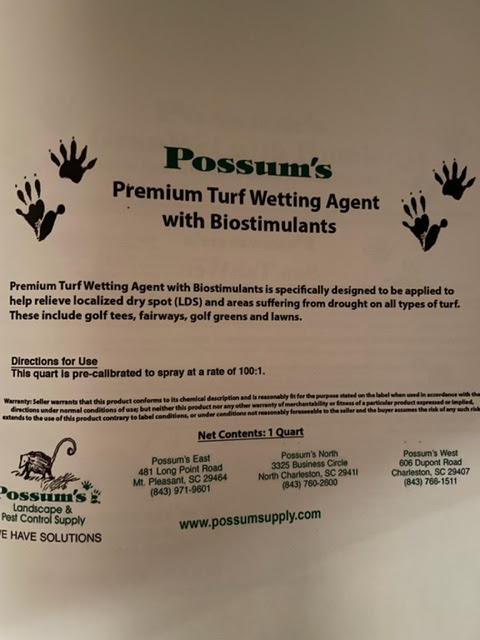
Use wetting agents this year.  Wetting agents have been shown to save approximately 30-60% of water consumption for a yard.  This would be a huge savings on your water bill.  By watering less, you will have less fungus problems and save money by not having to buy as much fungicides or water. At Possum’s we have noticed that a lot of people that use wetting agents save even more water because they are more in tune to their watering and their water bill. They are saving more like 80%, so if their water bill was $100.00 per month now the bill is only $20.00. A huge savings and water bills are usually more than $100.00. There are many other benefits to using wetting agents, and I was finally able to develop an easy RTS (connect straight to your hose) applicator. Your roots will grow deeper and you will be able to capture more nutrients, so you will get more out of your fertilizer.


In an effort to conserve water, it is time to get that hose that leaks at the faucet a new gasket. Check your irrigation. Are all the zones necessary or can you turn some off? Shrubs and trees should be established after one year or before. Are the heads spraying the way they were intended to spray?  If you need help, get the irrigation person over now before the spring rush.


In 2023 try to remove fertilizer and other control products from hard surfaces like driveways, sidewalks, pool decks, and streets before these products are washed into the storm water.  This will help protect the beautiful area in which we live.  Since a lot of storm water ends up in our marshes and waterways, this will also help protect our natural resources that we use for recreation, food, and jobs. You will also avoid that nasty staining.


Buy a 100 pack of disposable nitrile gloves.  These things are great!  You can use them when handling control products and fertilizers, when changing the oil in your lawn mower, while taking down your Christmas tree to keep sap off of your hands, while painting or taking out the trash, cleaning, picking up after your dog and yard work….  These gloves are very inexpensive and can save you lots of hot water while trying to remove things from your hands.  These gloves are also good at keeping the human scent away from mole, mice and rat bait.


In 2023, add organic matter to your lawn and beds.  Organic matter will also help you lower your water bill while adding many other benefits to your soil.  Cotton Burr compost has been improving Lowcountry soils with great results for the past 20 years.  If you want to see for yourself the benefits of cotton burr compost, measure a 100 square foot area in your turf (10 feet x 10 feet) and spread one 2 cubic foot bag. Check out the progress over a month. Many people feel their fungicide use has gone down after using cotton burr compost.


In order to combat weeds, plan to put out preemergents in your lawns and beds according to product label.  This will make your life a lot less stressful and your yard will be looking a lot better without weeds.  If time is a big issue, consider buying a year’s supply of product now, so you will have the product handy when it is time to apply. 


In 2023, always apply product according to the label’s directions.  No more, “if one ounce is good….two ounces will be real good”. Many of our fire ant products, less is better. On the pest control side of our business, roaches and rats can be repelled with too much product. Follow the label that has cost the manufacturer millions of dollars to get approval from the EPA and you will have better results. This will also save you money - not to mention the product label is a Federal Law. 


For those pet owners out there, whose animals have a history of flea problems, be proactive by applying growth regulators. Pivot Ultra Plus, Ultracide, Nylar, or Precor applied every three months, should keep your pet free of fleas. Rotate products with different active ingredients.


Always mow the grass with a sharp mower blade and prune the bushes with sharp pruning blades.  You will have cleaner cuts and less chance of disease. Take your mower to the shop for a tune-up before the spring rush.


Read a good book about gardening.  Reading is how we learn and it will motivate you as a bonus.  Picture books are fine.


Plant a plant for a pollinator – like milkweed, butterfly bush, bottlebrush, bee balm, salvia …


Happy New Year!